Job hunting and giving interviews is not something you do often that you can learn from your mistakes and improve upon. That is the reason I wanted to write this so you learn from my mistakes and see if what worked for me will work for you. I did my best to provide unique and new information that you may not find elsewhere.
💡 This is tailored for data scientist positions in top tech (FAANG) and equivalent companies. Some of it may apply to everyone like (Resume, Behavioral prep), but not all.
This is from MY personal experience. These are MY observations and things that worked for ME. Take inspiration from this and make changes that suit you and your objectives.
Being nice and personable goes a long long way. Don’t be `THAT’ person.
Getting referrals
💡 I did not get a single call from a recruiter when I applied directly on the portal. All my calls are a direct product of a referral except one.
Get Linkedin Premium. Its worth it.
A lot of referrals are from connections I made at random places at random times. So its always a good thing to build your professional network even if you are not hunting for a job.
Different ways I got my foot through the door
- I wrote a great cover letter describing how I perfectly match all their requirements and applied through the portal
- I reached out to the head of data science of a company who follows me on twitter and he expedited the process by sending my resume to the recruiter.
- I reached out to the head of data science who is my connection on Linkedin telling her about the talk I attended of her and that I was on the job market and asked her to connect me with a recruiter.
- I wrote to all data scientists who were in the company I was interested in through LinkedIn search and wrote to every one of them asking if I would be a good fit and if they would refer me.
- People would be more than happy to refer as there is usually an incentive like a referral bonus.
- I used the LinkedIn feature of “members in this company who are in your network” to ask them if they can refer me.
- I used the Linkedin feature of “members in this company who worked in the same company as you” to connect with them ask them if they can refer me.
- I used the Linkedin feature of “members in this company who went to your school” to ask them if they can refer me. This works because there is a common ground between you and the person.
- I asked my friend if they know someone who works for a company I am interested in and connected with them and asked them to refer me.
The reason I wrote the above is to illustrate that there are so many ways to get referrals if you try hard enough.
Resume and cover letter prep
A great resume will give you a shot at convincing the recruiter to move you forward. It also gets you through any automated system the company is using to filter resumes.
A great resume will
- Be relevant to the job you are applying (personalize).
- Project your strengths without explicitly saying them.
- Be very tight. Every section, every sentence, every word needs a reason to be there.
- Always be accompanied by a cover letter.
- cannot overstate the importance of a cover letter.
Resume is relevant to the job you are applying (personalize).
- Prioritize projects so it highlights what the job description says.
- Include any relevant projects where you remotely used the tools the job description talks about.
- Screening software and some recruiters see if the keywords in the job description matches the keywords in the resume.
Resume projects your strengths without explicitly saying it.
- I took Clifton strength assessment to understand what my strengths are and found a way to showcase them through what I did in the project sections without explicitly saying it.
- You can take yours here. https://store.gallup.com/p/en-us/10108/top-5-cliftonstrengths
- It is $19 and is totally worth it. The assessment not only gives you a path to crafting your resume, but it also gives you language to describe yourself, talk about your strengths and weaknesses.
Resume is very tight.
Every section, every sentence, every word needs a reason to be there.
This is to make sure you think through everything before you decide to keep it.
Follow this rule in writing your accomplishments
https://www.linkedin.com/pulse/20140929001534-24454816-my-personal-formula-for-a-better-resume/
Cover letter is very underrated
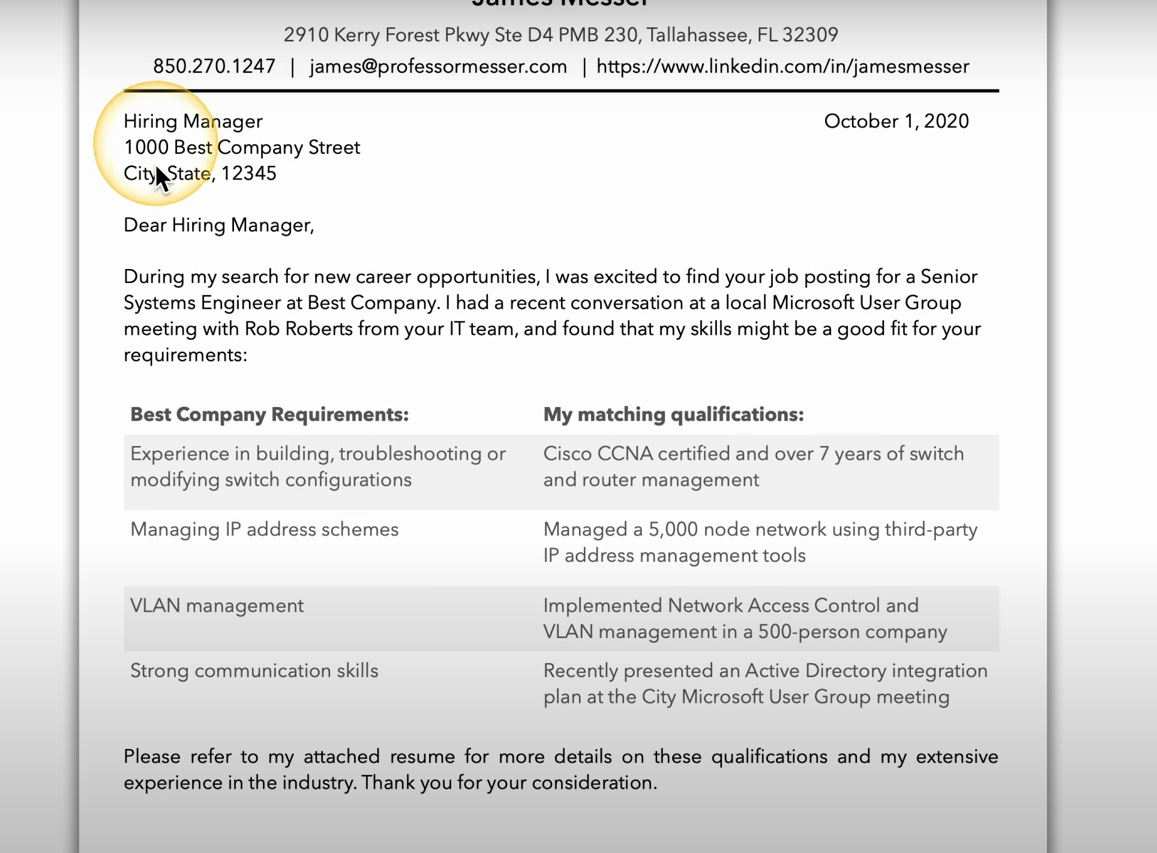
I cannot overstate how important this is. I was told repeatedly by recruiters how my cover letter made their job easier.
A good cover letter clearly shows how you fulfill all the job requirements like the example below. Source
Other references and notes
https://www.youtube.com/watch?v=Aarh4xjDD2g
This is a great video that talks about all things resume. It helped me a lot.
- My notes from the video
Does resume match what they are looking for. Match the job requirements
Top mistakes
Resume doesn’t match job requirements
- make sure the relevant skills are there
Customize resume for what the company is looking for
- Add those keywords in linkedin profile
- change summary in such a way that it is what they are looking for
- add skills that are similar to what they job desc asks for
- Keywords are key
- Make sure you do this to get through the resume scanner
Make sure you have place and state
10 second rule
- recruiters look just for 10 seconds
- single typep face
- use sans serif type face (arial, helvetica, calibri)
- keep atleast half inch margins
- no borders
Keep it professional
- this is a job application
- keep it professional
- no pictures
- no non-professional activities
Always proof read your resume
- both spelling and punctuation
- use present tense for present job and past tense for past job
Have someone else read it through
Resume is too long
- always single page for entry level page
- May be two pages for past positions and accomplishments (experienced person)
Display both months and years for duration
- bonus - add the duration
You didn’t describe the accomplishments
- dont just explain about the job duties
- accomplishments should be highlighted
Always include a cover letter
opportunity to make a good impression
explain the interest in the job
T cover letter
Don’t mislead or lie
Technical prep
💡 Pay for the premium version of interview prep websites like LeetCode. $30 a month subscription is totally worth it compared to the returns.
Data Science interviews test many technical skills depending on the role or the level.
Algorithmic Coding Prep
This is probably the most important component for software engineering roles, but not so much for data scientists. If you are interested in roles like Research Scientist, Research Data Scientist, then this will become important.
One mistake people do here is spend too much time worrying about this and too much time to get good at this.
Most interviews for data scientist roles will go into Arrays, but not so much into advanced concepts like binary trees. So spend most time in Easy and Medium Array questions.
Preparation:
- All array questions could be categorized into 6-7 building blocks (eg: Two sum problems, Binary Search problems, Reverse traversal problems). If you are comfortable with those building blocks, you could code any array question by relating it to a building block and modifying the boiler plate code of that building block. Same goes for other concepts. This is the best way to prepare.
- Best place to learn building blocks is https://interviewcamp.io/
- Practice questions at https://leetcode.com/. Mostly go for easy and medium level array questions.
- A very good subset of coding questions https://www.teamblind.com/post/New-Year-Gift—Curated-List-of-Top-75-LeetCode-Questions-to-Save-Your-Time-OaM1orEU
SQL
You cannot afford to bomb SQL rounds. So do well here.
Preparation:
https://mode.com/sql-tutorial/introduction-to-sql/ is the best place to brush up on SQL skills. Its concise and to the point
https://selectstarsql.com/ seems like a great place to learn SQL.
https://leetcode.com/problemset/all/?listId=5htp6xyg&page=1 has good practice questions.
My mode SQL notes
Data Coding
This round is about how you could manipulate data using pandas in python or similar libraries in R.
The only way to prepare for this round is by practicing as much as you can. No amount of reading will help here.
Practice EDA on many publicly available data sets (changing column types, treating missing values, feature selection, engineering, outliers) etc.
Practice coding famous algorithms like K-Means, Linear Regression, Decision trees, etc., from scratch.
Preparation:
- https://pandas.pydata.org/pandas-docs/stable/user_guide/groupby.html
- https://www.datacamp.com/
- https://www.kaggle.com/c/titanic for titanic data and example EDA’s
Causal Inference
https://www.mostlyharmlesseconometrics.com/
AB testing:
💡 I cannot tell you how much instrumental this book was in all AB testing rounds https://www.amazon.com/Trustworthy-Online-Controlled-Experiments-Practical/dp/1108724264 I read this book page to page twice.
Statistics
Prof. Charles Geyer (UMN Statistics) has the best slides on Intermediate Theory of Statistics I, II.
ML
One type of interview question is a case study where you would be given a use case and you need to walk them through what data you would need, what target variable you would choose, modeling procedure, evaluation metrics.
The best way to prepare for this would be to do some mock interviews.
Another type of question would ne just asking ML fundamentals like what is the difference between Lasso and Ridge regression and slowly going on from there by asking more and more questions.
In general you need to be familiar with how most ML models work and what are the advantages and disadvantages. This applies to all ML concepts.
Preparation:
- Some good cheat sheets: https://sites.google.com/view/datascience-cheat-sheets#h.h40dwqqwv30w
- Chris Albon’s flash cards are very useful: https://machinelearningflashcards.com/
- Other online source: https://towardsdatascience.com/the-data-science-interview-blueprint-75d69c92516c
Behavioral prep
💡 The key idea for this interview is to guage what kind of a person, teammate you will be and what experiences you had. This is the best time to showcase your strengths and show that you are aware of your weaknesses and are working on them.
I feel this is more of a damage control round in the sense that you need not impress them with your stories and answers as much as you need to make sure you don’t bomb this or say things that turn them off (eg. I have no weaknesses. I am perfect)
The best way to prepare for this round is to curate stories that have had an impact on you and helped you learn and grow. Have 5-6 of them and when a question is asked, you can relate it back to one of these stories.
There are ways to structure your answers using some methods like STAR and others which help. More about that in the link below.
https://sites.google.com/view/datascience-cheat-sheets#h.8bd6v3ijzuxv
Be likable and genuine. It goes a long way
As always, practice with your friends. That helps a lot. You don’t even need experts to conduct this mock interview. Just do it with your roommate, partner, or sibling.
Clifton strength assessment will help you understand your strengths and knowing your strengths can help you answer behavioral questions with more confidence. Cannot recommend this more.
- You can take yours here. https://store.gallup.com/p/en-us/10108/top-5-cliftonstrengths
Sometimes, your strengths can be your blind spots which could be considered as your weaknesses. Use the below link on how to relate your Clifton strengths to weaknesses
Case study prep
💡 Think of case study as some problem that you would arrive at your own company and solve it like you would solve that rather than looking at it as an interview question. This helps me a lot.
https://datainterview.com/ is one of the best sources for preparation.
Structure
- Structure in answering a case in very important. Ask why we want to do what we want to do. Ask clarification questions. Narrow the scope of the answer. Take time to think. State your assumptions. Work with the interviewer to get to the answer.
Rubric
- The interviewers evaluate your answer with a rubric. Whether the answer is right is just one point a rubric. Most people just focus on getting to the answer and forget that the evaluation is on a lot of other aspects.
- Some common rubrics.
- Did they ask clarification questions
- Did they scope the problem well
- Did they structure the problem well
- Did they arrive at a solution
- Is their solution technically sound
- Did they communicate what they want to do well
- Did they work with interviewer (take the hint) to arrive at a solution.
Business sense
- Always understand what the underlying business is. What is the mission of the company and what do they care about. What is their business model
- Always state this and discuss with your interviewer why we should care about doing what we are doing.
- It helps interviewers assess that you are not just solving the problem, but you understand the top level view.
Mock
- As always, the best way to improve upon this is get some professional mock interviews.
- They are very effective at evaluating you on a rubric and help you understand your weaknesses.
- https://datainterview.com/ is a great place for this.
Offer negotiations and timing
💡 Companies are NOT doing you a favor by offering you a job. Its an open market and market decides the price.
I don’t have anything new to say hear. everything is covered in detail in the blogs below. These blogs are gold.
https://haseebq.com/my-ten-rules-for-negotiating-a-job-offer/
https://haseebq.com/how-not-to-bomb-your-offer-negotiation/
https://www.kalzumeus.com/2012/01/23/salary-negotiation/
A recruiter view of offers and negotiations
https://www.teamblind.com/post/kind-of-new-recruiter-ama-a31aHx3q
But I will cover things that were hard for me to internalize.
Will they recede the offer if you ask them for more compensation?
NO
The cost of interviewing a candidate is way too high. So, if a company decides to make you an offer, the opportunity cost of finding someone else and negotiate with them is way too high. They would rather give you some extra compensation and sign you than take that risk.
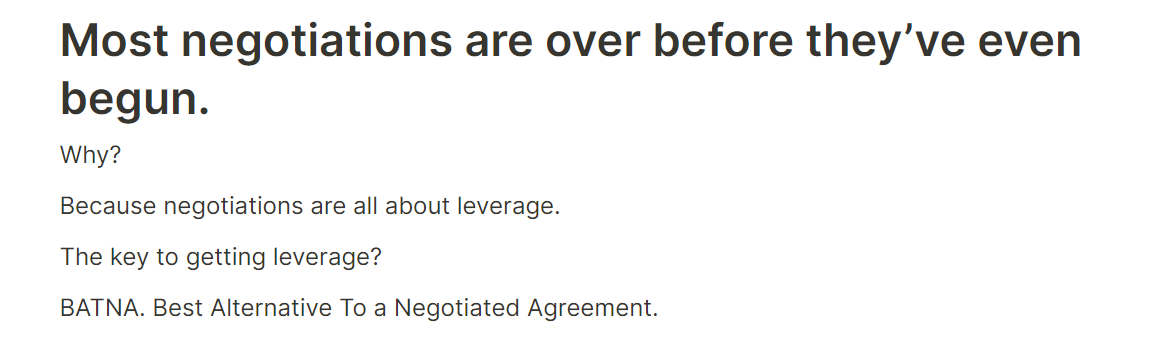
Have competing offers. Get your BATNA straight
The amount of leverage this gives you is crazy. This cannot be understated. Leverage is everything in a negotiation. This is same in any industry. Look at this example from a car dealer.
https://cardealershipguy.org/my-experiences
Treat job market as Dating market.
I got this advice from a recruiter once. You need to be winnable for the company to keep you in negotiations. If they get a signal that you are not really interested, they may end things. So, keep telling them why you are interested in the company every time you ask them for more.
Some things about the entire process that stood out and I was surprised when I learned.
- Some companies shortlist resumes using automated software and some recruiters may not be qualified to understand your relevance for the role. So curate your resume for the software and recruiters. Once, you get through these hurdles, you can sell yourself to the team.
- Cover letters are very impactful. Even if the company does not have a field to upload cover letter, try to squeeze it in somehow.
- Try to get as much information from recruiters as possible. Ask them for sample questions. Ask them for as much information about the interview and interviewer as possible.
- The entire interview process from application to offer takes longer than you expect.
- Mock interviews are so underrated. Take as many as possible with your friends, colleagues. MOCK. MOCK. MOCK.
- Be strong at your basics. I feel most of the interviews are not trying to trick you. That want to assess the strength of your basics. For example. in statistics interviews, they would not ask you to derive variance for the negative binomial distribution, but they might ask you about the variance of sample mean.
Best way to reach me is via Twitter or LinkedIn DM’s